
Five technologies, one aim: helping the body use oxygen more efficiently.
They resemble each other and are often used interchangeably, but they do different things. This overview helps you decide which direction suits your users, your space and the way you work.
Hard chamber
A steel chamber pressurised to 1.5 or 2.0 ATA. Oxygen reaches the user directly through a mask or BIBS system. The strongest construction, the highest pressures, and built for intensive daily use.
Recovery and performance centres, clinics, premium home installations
Learn moreSoft chamber
A soft chamber of multi-layer TPU with a working pressure of 1.4 or 1.5 ATA. Lighter, more compact and easier to place than a hard chamber, and the accessible entry point into hyperbaric oxygen training.
Home use, practices, care and rehabilitation
Learn moreHypoxic-hyperoxic
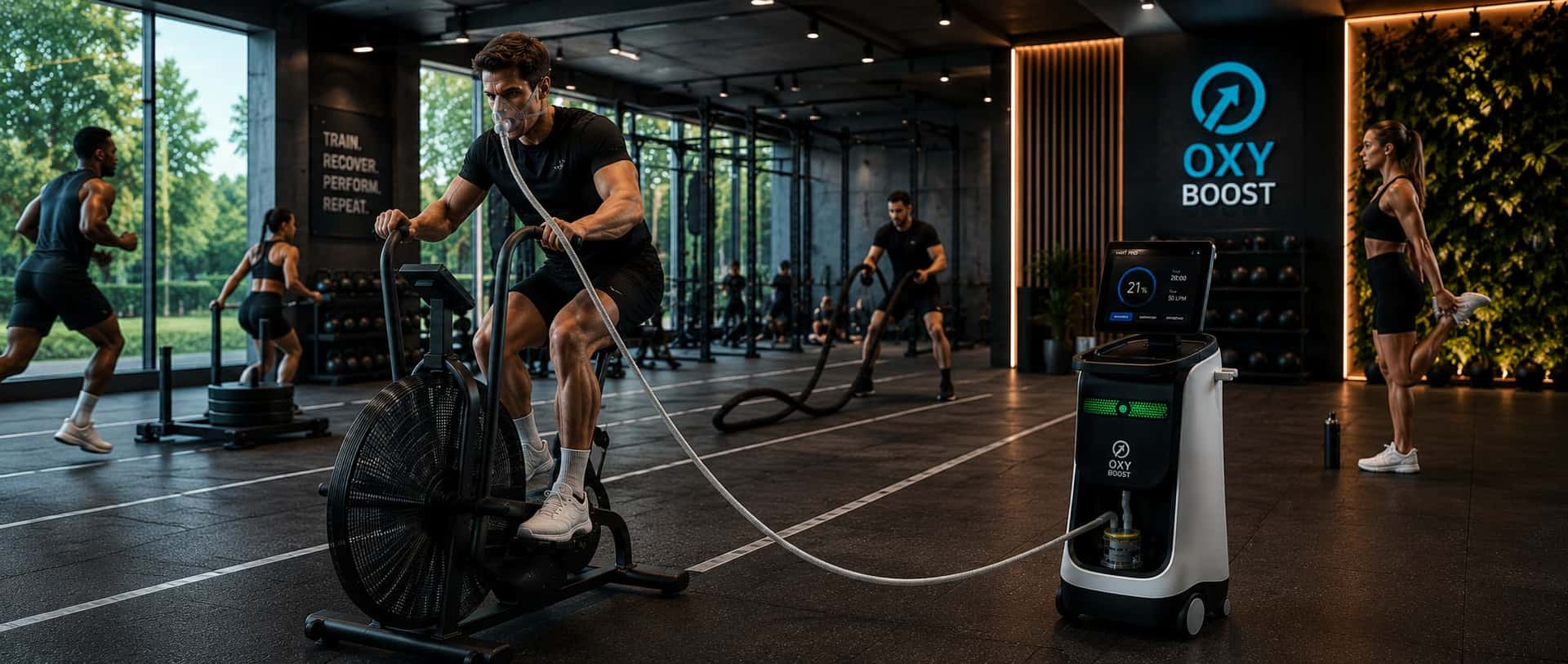
Interval training with air: alternating oxygen-reduced and oxygen-enriched air, driven by the user's blood oxygen saturation or heart rate. No pressure, no chamber, just a mask and a unit.
Sport, recovery, energy and vitality programmes
Learn moreAltitude simulation
Oxygen-reduced air only, simulating altitude up to 6,500 metres. Intended for targeted altitude adaptation rather than interval training.
Mountain sports, treks and competition at altitude
Learn moreMolecular hydrogen
Hydrogen gas inhaled through a nasal cannula. Where oxygen training increases supply, hydrogen addresses the balance between oxidants and antioxidants. Combines well with both other technologies.
An addition alongside HBOT or IHHT, and for home use
Learn morePressure or no pressure
Combining pays off
It all starts with breathing.
Breathe along with the circle: four counts in, a short hold, four counts out. How your body takes in and uses oxygen is exactly what our systems are about.
Compare HBOT and IHHTWhere would you like to go next?
That is the best way to choose.
Our showroom in Goes has many of our systems set up and running. Take a session, feel the difference between the technologies and work through with us what it would mean at your location.