
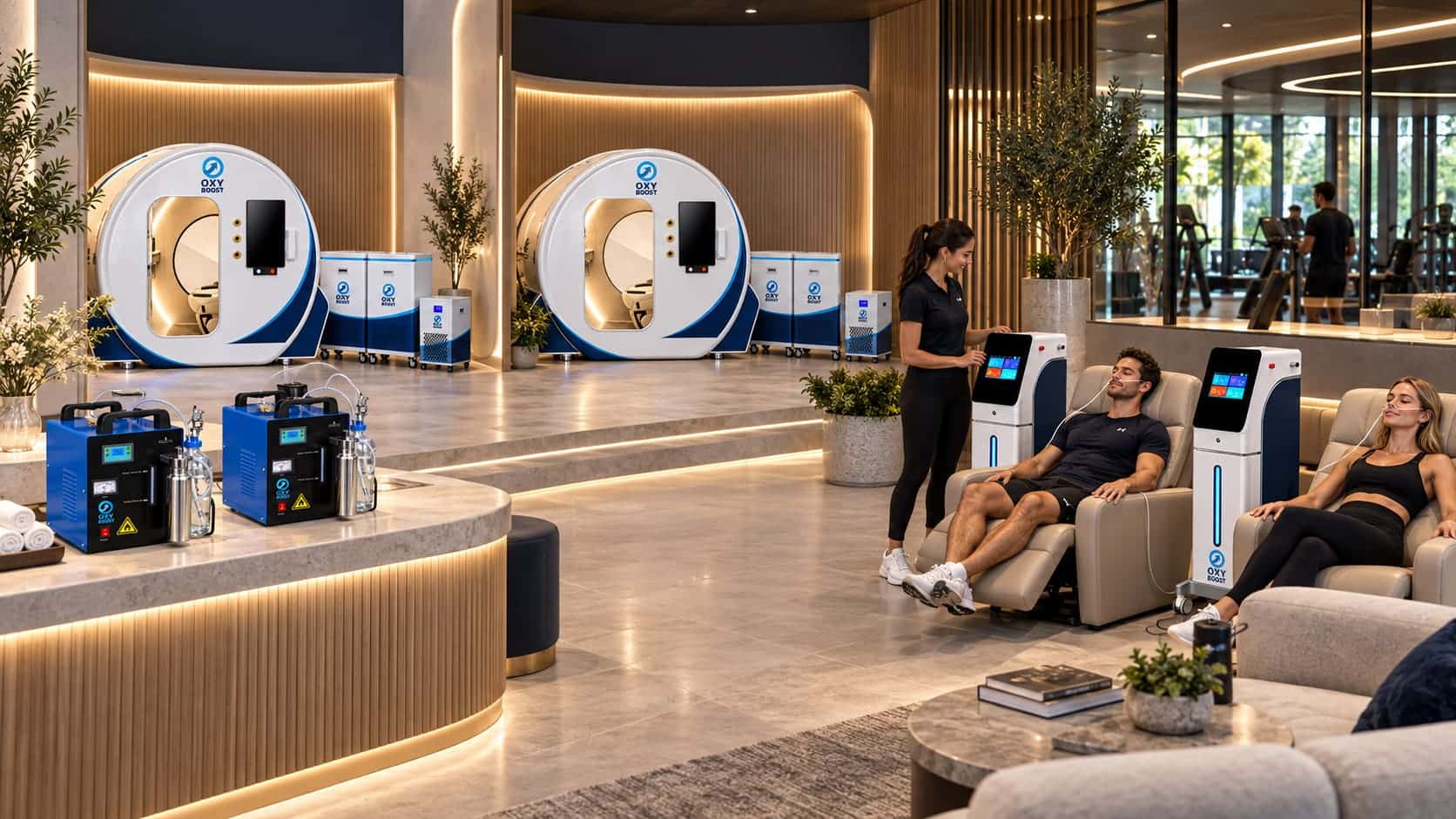
HBOT vs IHHT: what is the difference, and which one do you need?
Hyperbaric oxygen (HBOT) and intermittent hypoxic-hyperoxic training (IHHT) are often mentioned in the same breath, but they do different things, need different rooms and suit different users. The comparison, side by side.
Swipe to compare everything
| Aspect | HBOT | IHHT |
|---|---|---|
| Principle | Oxygen-enriched air under raised pressure (1.4 to 2.0 ATA) in a chamber | Alternating oxygen-reduced and oxygen-enriched air at normal pressure through a mask |
| Equipment | Hard or soft chamber plus concentrator, booster and cooling | One unit on castors, a mask and a wireless SpO₂ finger clip |
| Session | On average 60 to 90 minutes; relax, read or watch a film | Around 50 to 60 minutes; passive or active with a bike or treadmill |
| Space | Chamber plus around one metre of clear space; separate place for peripherals | A treatment room, recovery room or living room |
| Power | Hard chamber: several kilowatts, dedicated circuit advisable | Ordinary wall socket |
| Supervision | Sessions largely run themselves | More attention in the first sessions; settings per user |
| Users per day | One per session (two in the DUO) | Many changing users, back to back |
| Typical programmes | Recovery, performance, longevity, premium home | Sport, recovery, energy and vitality |
| Entry point | Boost Seat 90 soft chamber, in stock and to rent | IHHT HOME, compact and in stock |
What HBOT does
During a hyperbaric oxygen session you breathe oxygen-enriched air under raised pressure inside a chamber. This allows considerably more oxygen to be absorbed and transported by the body than with normal breathing. What you may notice is a light pressure on your ears while the pressure builds, comparable to an aircraft. The pressure is built up and released calmly and you can communicate with the operator at any moment.
What IHHT does
IHHT alternates short, controlled phases of oxygen-reduced air with phases of oxygen-enriched air, driven on our systems by the user's blood oxygen saturation or heart rate. The body is exposed to altitude-like conditions in intervals without leaving the room. No pressure, no chamber: just a mask and a unit.
When HBOT
When depth and comfort matter: recovery and performance programmes in a centre, a longevity clinic where the session is part of the brand, or a premium home installation. Hard chambers for intensive daily use; a soft chamber as the accessible entry point.
When IHHT
When many different users train back to back, when space and power are limited, or when you want to start with a compact unit. Sport, recovery, energy and vitality programmes, in a centre, a practice or at home.
Our view: it is rarely either-or
HBOT and IHHT: common questions
Can I combine HBOT and IHHT?
Yes, and many of our clients do. HBOT and IHHT can run side by side in one location, and we help you build programmes that combine them.
Which is better for athletes?
Athletes often use both: IHHT for a training stimulus and active sessions with a bike or treadmill, HBOT for recovery between sessions. The two-person DUO chamber lets an athlete and a coach share one session.
Which needs less space?
IHHT. A unit on castors, a mask and an ordinary wall socket. A hard chamber needs the chamber plus around one metre of clear space and a separate place for the concentrator, booster and cooling.
Who uses HBOT and IHHT?
Athletes, recovery and performance centres, clinics, practices and private users. Settings are determined per user and our team trains your operators in safe use. If you have health complaints, discuss your plans with your physician before starting.
Where would you like to go next?
That is the best way to choose.
Our showroom in Goes has many of our systems set up and running. Take a session, feel the difference between the technologies and work through with us what it would mean at your location.