
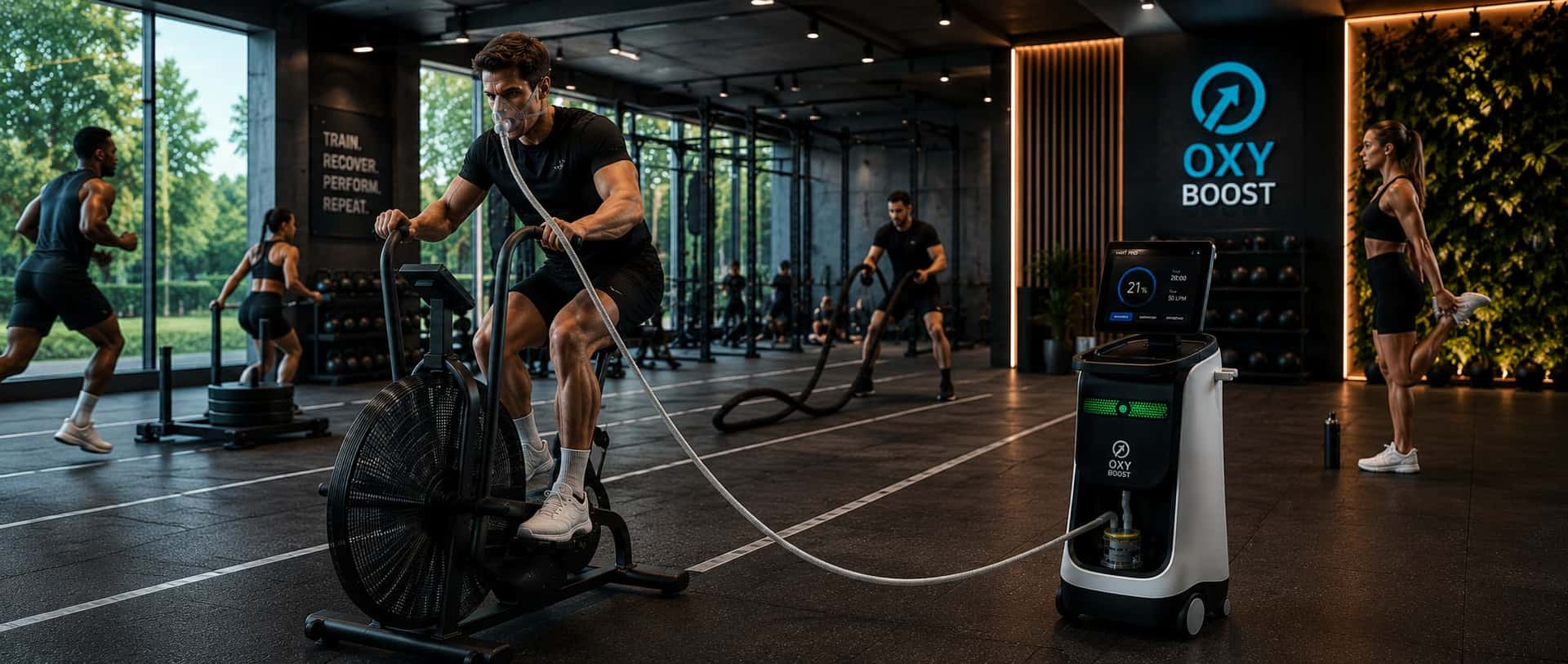
Cycling: altitude, oxygen and recovery
Pros go to altitude camps, but you can bring the mountain home. For cyclists, oxygen is the currency of every climb and every time trial.
Altitude training simulates thin air on the bike or at rest, the classic way to build endurance. IHHT adds oxygen-rich phases between the hypoxic ones and can be done while pedalling easily. Mild HBOT is used after long rides and block training.
Studies on cycling measured higher aerobic capacity during a maximal cycle-ergometer test with mild hyperbaric oxygen, and better recovery, sleep and VO2max after six days of fatiguing rides followed by mild HBOT. Reviews of live-high-train-low programmes describe gains in VO2max and time-trial performance in endurance athletes.

We use it ourselves
This theme is personal for us. Our team and people close to us use oxygen training themselves, and we gladly share what we have experienced. Come and try it in the showroom, or send us a message.
What researchers measured
The studies and data come from the researchers and journals cited, not from OxyBoost. We show them for information only.
- Mild HBOTCrossover study2025
Mild hyperbaric hyperoxia improves aerobic capacity and suppresses cardiopulmonary stress during the maximal cycle-ergometer test
Hisamoto K, et al. · PLOS ONE (2025)
19 healthy men
Participants cycled under three conditions, including 1.3 ATA with 35% oxygen. Under mild hyperbaric conditions the work rate at the ventilatory threshold was higher, while systolic blood pressure at that threshold was lower.
- Mild HBOTCrossover study2026
Mild hyperbaric oxygen therapy on subjective sleep quality, aerobic, anaerobic exercise test, brain and muscle tissue oxygenation response in Chinese University male athletes after muscle fatigue
Qu C, et al. · BMC Sports Science, Medicine and Rehabilitation (2026)
12 national-level male athletes
After 90 minutes of fatiguing cycling, the athletes recovered either with mild HBOT or without it, on six consecutive days. With mild HBOT, subjective sleep quality was better, muscle and brain oxygenation were higher, and 24 hours later VO2max, peak cycling power and time to exhaustion were higher.
- Altitude trainingReview2023
Physiological and performance effects of live high train low altitude training for elite endurance athletes: A narrative review
Bonato G, et al. · Current Research in Physiology (2023)
Review for elite endurance athletes
Reviews 'live high, train low' in running, cycling, swimming and triathlon. After such programmes athletes often improve maximal oxygen uptake, time-trial performance and peak power; the review also summarises the hypoxic doses most often used.
- IHHTCrossover study2024
Acute psycho-physiological responses to submaximal constant-load cycling under intermittent hypoxia-hyperoxia vs. hypoxia-normoxia in young males
Behrendt T, et al. · PeerJ (2024)
15 healthy, recreationally active young men
Participants cycled for 40 minutes with alternating low- and high-oxygen intervals, low-oxygen and normal-air intervals, or normal air. With high-oxygen recovery intervals, oxygen saturation recovered faster and heart rate and lactate stayed lower than with normal-air intervals.
Discover other themes
Where would you like to go next?
That is the best way to choose.
Our showroom in Goes has many of our systems set up and running. Take a session, feel the difference between the technologies and work through with us what it would mean at your location.