
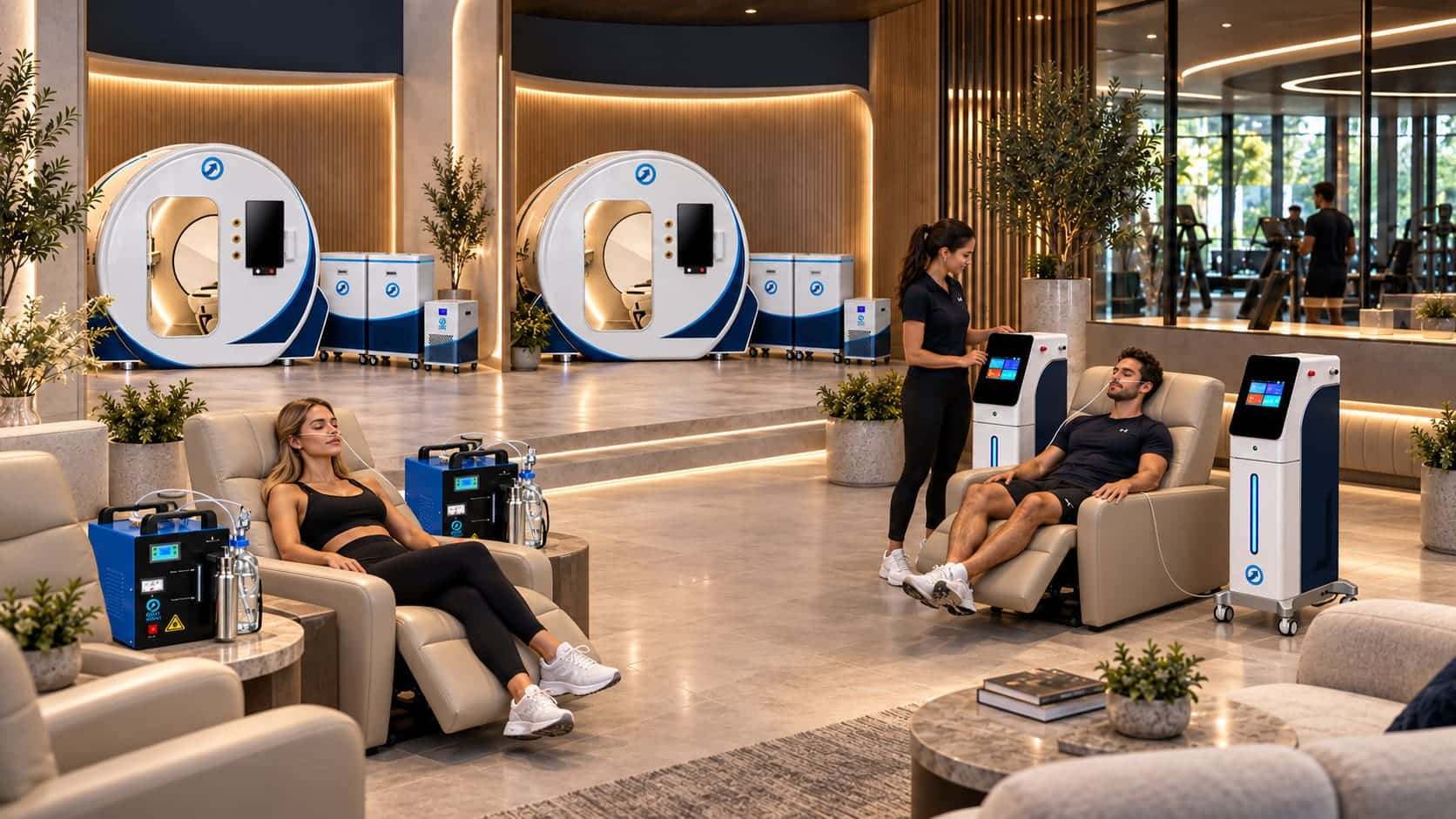
Faster recovery and better performance
Training is the stimulus, recovery is where you get better. For athletes, teams and anyone who trains hard, the gap between two efforts decides how far they get.
Recovery after a match or a hard session, a full calendar, a quick turnaround between competitions: that is where oxygen systems are used in sport. HBOT after exercise, IHHT and altitude training to build capacity, and hydrogen around repeated sprints.
Studies in athletes measured better performance in a second exercise test after post-exercise hyperbaric oxygen, higher VO2max after a series of HBOT sessions, better sea-level sprint performance after repeated-sprint training in hypoxia, and less drop-off in late sprints with hydrogen.

We use it ourselves
This theme is personal for us. Our team and people close to us use oxygen training themselves, and we gladly share what we have experienced. Come and try it in the showroom, or send us a message.
What researchers measured
The studies and data come from the researchers and journals cited, not from OxyBoost. We show them for information only.
- Mild HBOTCrossover study2023
Post-Exercise Hyperbaric Oxygenation Improves Recovery for Subsequent Performance
Mihailovic T, et al. · Research Quarterly for Exercise and Sport (2023)
12 trained cyclists
After a fatiguing effort, cyclists recovered for 75 minutes either at 1.3 ATA with 97% oxygen or passively. After the mild hyperbaric recovery their power in a 5-minute maximal effort was higher, heart rate variability recovered better and perceived recovery the next day was better.
- HBOTRandomised trial2022
Effects of Hyperbaric Oxygen Therapy on Mitochondrial Respiration and Physical Performance in Middle-Aged Athletes: A Blinded, Randomized Controlled Trial
Hadanny A, et al. · Sports Medicine – Open (2022)
37 healthy master athletes aged 40–50
Forty sessions at 2.0 ATA were compared with a sham protocol. The HBOT group showed higher VO2max and oxygen uptake at the anaerobic threshold, together with changes in mitochondrial respiration and mitochondrial mass.
- Altitude trainingMeta-analysis2017
Effects of Repeated-Sprint Training in Hypoxia on Sea-Level Performance: A Meta-Analysis
Brocherie F, et al. · Sports Medicine (2017)
9 controlled studies, 202 athletes
Repeated-sprint training in hypoxia was compared with the same training in normal air. It produced a larger improvement in mean repeated-sprint performance at sea level; differences in best sprint and VO2max were not significant.
- HydrogenCrossover study2022
Molecular Hydrogen Mitigates Performance Decrement during Repeated Sprints in Professional Soccer Players
Botek M, et al. · Nutrients (2022)
16 professional football players
Players drank hydrogen-rich water or a placebo before 15 sprints of 30 metres. With hydrogen, the last sprints were 1.9–3.4% faster, pointing to less fatigue late in the test.
Discover other themes
Where would you like to go next?
That is the best way to choose.
Our showroom in Goes has many of our systems set up and running. Take a session, feel the difference between the technologies and work through with us what it would mean at your location.